top of page


ひらがな
Hiragana
Around the 9th century, the Japanese developed their own writing system based on syllables: hiragana and katakana (together: kana). Of the two kana systems, hiragana is more cursive, while katakana characters are more angular.
Hiragana and katakana each consist of 46 signs which originally were kanji but were simplified over the centuries. Among the syllables are the five vowels (a i u e o). The rest are syllables combined by one of these vowels with a consonant (ka ki ku ke ko ra ri ru re ro...). One exception is the n. Even though one can theoretically write the whole language in hiragana.
Hiragana is the first of all the writing systems taught to Japanese children. Many books for young children are, therefore, written in hiragana only.

Hiragana Chart | Free Japanese Alphabet Chart for Beginners (Printable PDF)
日本語学習者向け無料 ひらがな表【読み方・発音・印刷対応】
Free Hiragana chart for Japanese learners. Easy-to-read AIUEO order chart with pronunciation guide, perfect for beginners, JLPT study, and classroom use. Printable PDF and English-friendly version available.
(1)Hiragana Chart
(2)Hiragana Chart with Roman letters

Hiragana Practice Worksheet | Learn Vocabulary, Writing & Pronunciation
ひらがな練習ワークシート| 語彙・書き取り・発音を学べる無料教材【子供・初心者向け】
Illustrated Hiragana practice worksheet for kids and beginners. Learn Japanese vocabulary, practice writing Hiragana characters, and study pronunciation independently with reading guides. Easy and fun printable worksheet.
(1)Hiragana Writing Practice worksheets | Level 1 ★
(2)Hiragana Writing Practice worksheets | Level 2 ★★

Katakana
カタカナ
Katakana is a syllabary composed of 46 characters, and is characterized by the use of straight lines and sharp corners. It is one of the three Japanese writing systems, along with hiragana and kanji.
Katakana are used mainly to write loan words (words borrowed from other languages) and non-Japanese names, as well as to denote the various sounds and cries of animals
Katakana were developed in the ninth century and are also derived from more complex kanji.

Katakana Chart | Free Japanese Alphabet Chart for Beginners
カタカナ表|日本語学習者向け無料教材【読み方・発音・印刷対応】
Free Katakana chart for Japanese learners. Easy-to-read AIUEO order chart with pronunciation guide, perfect for beginners, JLPT study, and classroom use. Printable PDF and English-friendly version available.
(1)Katakana Chart
(2)Katakana Chart with Roman letters

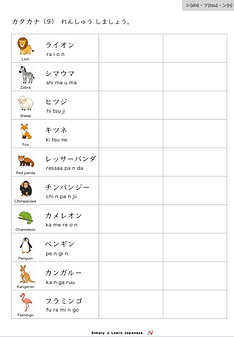
Katakana Practice Worksheet | Learn Vocabulary, Writing & Pronunciation
カタカナ練習ワークシート|語彙・書きとり・発音を学べる無料教材【子供・初学者向け】
Illustrated Katakana practice worksheet for kids and beginners. Learn Japanese vocabulary, practice writing Katakana characters, and study pronunciation independently with reading guides. Easy and fun printable worksheet.
(1)Katakana Writing Practice worksheet | Level 1 ★
(2)Katakana Writing Practice worksheet | Level 1 ★
(3)Katakana Writing Practice worksheet | Level 1 ★
(4)Katakana Writing Practice worksheet | Level 2 ★★
(5)Katakana Writing Practice worksheet | Level 2 ★★
(6)Katakana Writing Practice worksheet | Level 2 ★★
(7)Katakana Writing Practice worksheet | Level 2 ★★
(8)Katakana Writing Practice worksheet | Level 2 ★★
ひらがな & カタカナ

読む
Reading
くりかえし 読む練習をしましょう。
読みかたが わからないときは、
ローマ字の文を 読みましょう。
つぎに、日本語の文を 読みましょう。
Practice reading repeatedly.
If you don't know how to read it,
read the sentence in romaji.
Next, read the sentence in Japanese.

書く
Writing
ノートに 書いて練習しましょう。
くりかえし書いて、ひらがなと
カタカナが スラスラ書けるように
なりましょう。
Practice writing them in your notebook. Write them repeatedly until you can write hiragana and katakana fluently.

日本語の文を読みながら
ノートに書きましょう。
助詞(じょし)の使いかたを
おぼえましょう。
Read Japanese sentences and write them down in your notebook. Learn how to use particles.
覚える
Memorizing
ひらがな・カタカナ練習PDF
JLPT N5対応 無料ダウンロードワークシート
この無料PDFワークシートでは、よく使われる日本語フレーズを書く練習 を通して、ひらがなとカタカナを自然に身につけることができます。
実際によく使う言葉や短い文を書くことで、文字・語彙・文法をまとめて学習できます。日本語初心者や独学の方におすすめです。
このワークシートでできること
・ひらがな・カタカナを書く練習
よく使われる語彙やフレーズを書きながら文字を
覚えられます。
・語彙力アップ
日常会話でよく使う言葉を学べるので、自然に語彙が
増えます。
・文法の基礎を学べる
短い文を書くことで、主語・動詞・助詞(は・を・に・ で など)の使い方を理解できます。
・JLPT N5対策に対応
日本語能力試験N5レベルの基本語彙・文法の学習に
役立ちます。
・独学にも最適
初級学習者が一人でも取り組みやすい内容です。
おすすめの学習者
-
日本語を初めて学ぶ方
-
ひらがな・カタカナを復習したい方
-
JLPT N5を受験予定の方
-
子ども・大人の初心者学習者
-
独学で日本語を勉強したい方
Hiragana & Katakana Practice PDF
Free Download Worksheet for JLPT N5 Beginners
This free downloadable PDF worksheet helps learners practice Hiragana and Katakana through writing common Japanese phrases.
Learners write useful words and short sentences, allowing them to improve writing, vocabulary, and grammar at the same time. Perfect for beginners and self-study learners.
What You Can Learn
-
Practice writing Hiragana and Katakana
Learn Japanese characters by writing useful words and phrases. -
Build vocabulary
Study common everyday Japanese expressions and expand your vocabulary naturally. -
Learn basic grammar
Practice short sentences to understand subjects, verbs, and particles such as wa, wo, ni, and de. -
JLPT N5 ready
Covers essential vocabulary and grammar for the JLPT N5 level. -
Great for self-study
Easy-to-use worksheets for independent learners.
Recommended For
-
Complete beginners learning Japanese
-
Students reviewing Hiragana and Katakana
-
JLPT N5 learners
-
Children and adult beginners
-
Self-study Japanese learners
Hiragana & Katakana Practice Worksheet | ひらがな・カタカナ れんしゅう
Hiragana & Katakana Free PDF Worksheet (Beginner-Friendly)
Example sentences :
Daily routine expressions in Japanese
【英語 English】
【日本語 Japanese】
【日本語 Reading (Roman letters)】
1. get up at 7
2. take a shower
3. wash my face
4. get dressed
5. brush my teeth
6. eat breakfast
7. drink coffee
8. go to school
9. talk with my friend
10. eat lunch
7じ に おきます。
シャワー を あびます。
かお を あらいます。
は を みがきます。
ふく を きます。
あさごはん を たべます。
コーヒー を のみます。
がっこう に いきます。
ともだち と はなします。
ひるごはん を たべます。
shichiji ni okimasu
shawaa wo abimasu
kao wo araimasu
ha wo migakimasu
fuku wo kimasu
asagohan wo tabemasu
koohii wo nomimasu
gakkou ni ikimasu
tomodachi to hanashimasu
hirugohan wo tabemasu


bottom of page